Moonbase Persistent Agent Workbench: technical specification
By Andy Herman
1. Scope and implementation status
This is an engineering specification of the implemented first Workbench release, with evidence dated October 13, 2026. It is not a peer-reviewed performance study, a claim of autonomous quality or a provider-billing guarantee. The companion build article explains the product change; the Moonbase hub retains the project’s history.
The private application is deployed with authenticated Workbench routes. Actual local desktop and resized-mobile browser captures establish the working UI, live receipt stream and idle state. Native behavior was separately exercised through four isolated Copilot submissions: one retained initial failure and three successful tasks. Claude SDK activation remains blocked pending permitted documented authentication.
A subsequent scoped-maintenance correction is merged and validated in source and controlled fixtures. It is not installed as a new production helper or a new admission profile for the restarted application. References to that correction below state its implemented source contract, not a live maintenance deployment result.
2. Product goal and non-goals
The goal is an owner-directed interface for durable specialist work: assign a deliverable, leave the browser, check progress, direct a later turn, inspect artifacts and retain reviewed lessons. A specialist’s behavior is shaped by versioned instructions, examples, selected tools, explicitly granted knowledge and scoped approved memory.
The first release does not train model weights, adopt existing desktop conversations, copy personal-bot memory, recursively ingest a vault or launch paid idle loops. It does not supply an OS sandbox, universal process-absence attestation, automatic fact checking, a hard monetary limit or a general publishing/merge authority.
The 3D habitat remains optional. Existing PTY workers, missions, queues, project floors, meetings and the whiteboard retain separate contracts. Read-only Neural Bridge observations do not become controllable SDK sessions.
3. System boundary and components
| Component | Responsibility |
|---|---|
| Independent 2D Workbench | Task composition, live receipts, profiles, sources, decisions, outcome review and memory. |
| Authenticated Node server | Session/RBAC enforcement, record validation, capacity accounting and HTTP/SSE delivery. |
| Server-owned supervisor | Explicit backlog dispatch, native lifecycle, direction at turn boundaries and cleanup accounting. |
| Native adapter | Moonbase-created provider session, structured messages/tool events and provider-reported usage. |
| Project workspace | Owned run worktree, constrained file operations and approved verification. |
| Private durable store | Versioned records, ordered events/checkpoints, immutable artifacts and activity inventory. |
| Optional habitat | Existing real PTYs and truthful projections through original Blender stations. |
| Read-only observer | Minimal observations of external Neural Bridge runtimes, without dispatch or session adoption. |
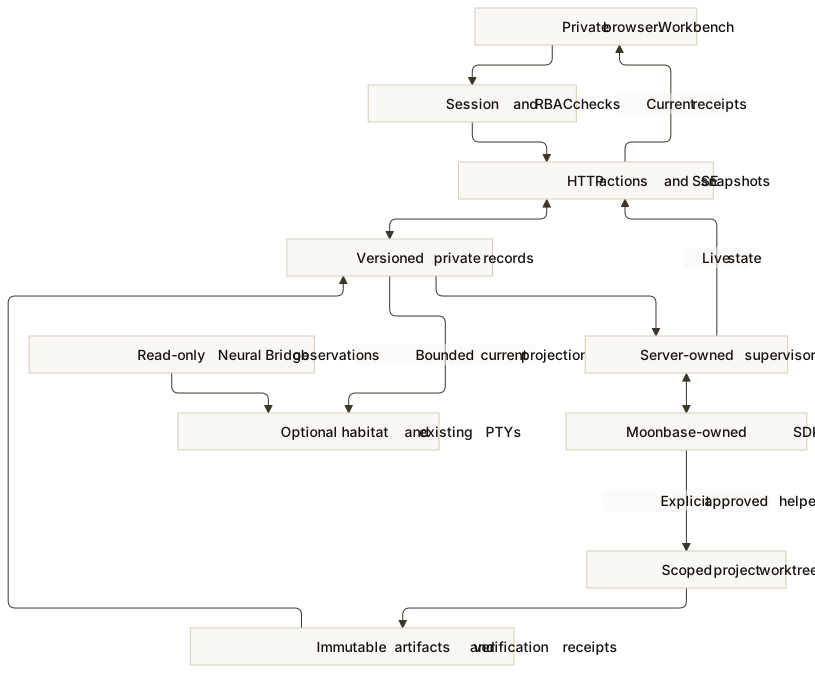
The snapshot/event path is observational. It does not replay actions after a browser reconnect and does not renew a lease that keeps a native task alive. The host must remain available; a browser-independent supervisor is not a machine-reboot or always-on cloud availability guarantee.
4. Runtime and interface surface
Implementation pins are a release snapshot, not a claim about the vendors’ latest available versions.
| Technology | Reviewed implementation |
|---|---|
| Server and shared contracts | TypeScript and Node; reviewed local host uses Node 22.22.2. |
| Workbench client | Independent DOM/Vite entry, usable without WebGL. |
| Optional room | Three.js with reproducible Blender GLB assets. |
| GitHub Copilot | SDK 1.0.19, bundled runtime 1.0.95. |
| Claude Agent | SDK 0.3.296, bundled runtime 2.1.296. |
| Record validation | Zod 4.3.6 plus bounded physical-path/file readers. |
| Private remote access | Cloudflare Access plus application authentication; local host remains the origin. |
The primary post-login entrance is /workbench. /room retains the habitat;
/missions retains the mission workspace; /work is the separate restricted
finite bridge. These are not aliases for a shared uncontrolled execution mode.
| Read interface | Meaning |
|---|---|
GET /api/workbench | Current bounded authenticated Workbench snapshot. |
GET /api/workbench/events | Authenticated snapshot/heartbeat stream with repeated authority checks. |
GET /api/workbench/inventory | Typed counts for work, waits, cleanup, SDK/probes/verifiers and writer locks. |
GET /api/admin | Owner administration/status, including Workbench inventory. |
Mutation routes are server-owned actions with current revision and authority checks. Engine readiness is an explicit check, not part of page load. Unknown or unverified model catalogs are not populated from guesses.
5. Durable data model
| Record | Important bindings |
|---|---|
| Profile | Stable identity and versions of purpose, instructions, style, tools, examples, project/source grants and rubric. |
| Workstream | Registered project, goal/version, selected sources, verification presets, priority backlog and paused state. |
| Run | Owned worktree/native identity, engine/model request, pinned profile/workstream/context versions, limits, revision and lifecycle. |
| Source | Exact selected text-file identity/version, relative path, size, timestamp, hash and inclusion/freshness/revocation state. |
| Permission | One run/session/profile/action-bound request, current authority and one-use decision. |
| Artifact/outcome | Exact captured content/workspace hashes, source/profile/engine provenance, diff and verification receipts. |
| Memory lesson | Originating run, profile/workstream scope, displayed versions and proposed/approved/revoked/deleted state. |
| Activity | Owned SDK connections, probes/verifier processes, writer locks and unresolved cleanup. |
Profile and workstream edits are versioned. Each explicit run captures its own context pins. Already queued or ongoing runs are not silently reconfigured by later edits or memory approval.
Engineering, Teaching, Research and Content start as generic source-backed templates without project grants. Passive listing does not write them into durable state or open SDK/auth/model connections. An unknown existing subtree is refused rather than reset.
6. Execution and approval protocol
Task admission requires an administrator, a workstream, an explicitly granted profile/project relationship, verified permitted engine readiness and owner consent for the pinned context and scoped tools.
The supervisor reserves existing whole-app capacity. SDK connections, readiness probes and legacy workers share that limit; an SDK run is not invisible because it lacks a PTY. A workstream does not overlap native runs or silently dispatch past outcome review.
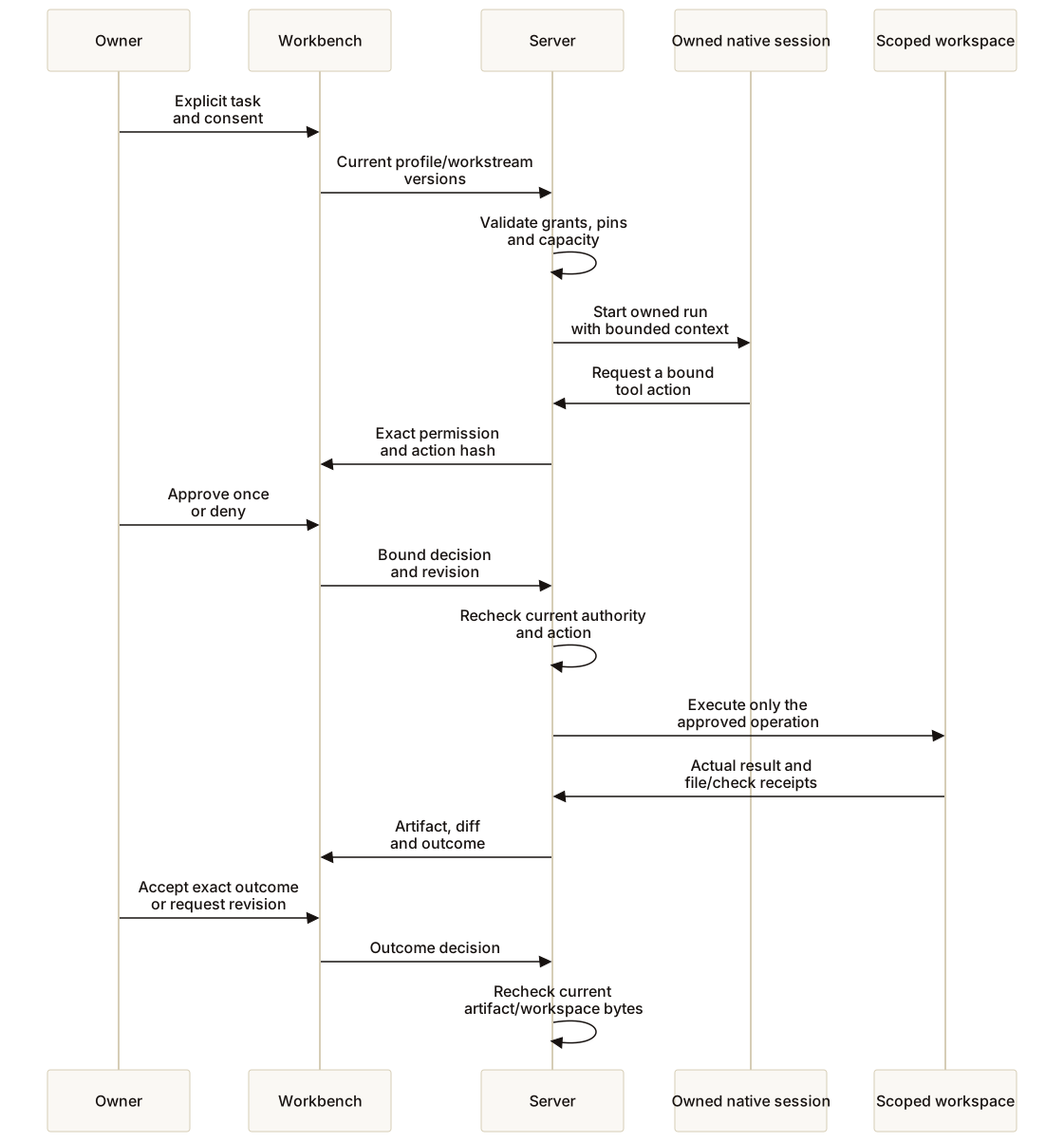
Semantic answers, direction, tool permission, outcome acceptance and memory approval are distinct actions. Natural language does not grant a file write, network egress, publishing or merge. There is no approve-all permission mode in the constrained Moonbase helpers.
Direction is durable and admitted once at an appropriate native turn boundary. A checkpoint records local evidence without a new model prompt. Stop requests cleanup and pauses backlog dispatch; requested cancellation is not confirmed cleanup. Owner waits pause the active-time allowance without generating paid reminders.
Resume requires explicit consent, confirmed cleanup and unchanged pins. Switching engine creates a new run/worktree/native identity with an approved structured handoff. It does not migrate hidden conversation or restore revoked context.
7. Native ownership and authentication
Only native sessions created in Moonbase’s private SDK namespace are resumable. Existing desktop chats are not adopted, controlled or presented as new Moonbase tasks. SDK messages and tool receipts are structured events, not fabricated terminal output.
Ambient instruction/configuration/plugin/skill discovery, shared native memory/session retrieval and built-in tool access are constrained by the adapters. Selected model IDs come from a verified catalog or an explicit native default; the actual reported model/version belongs in the receipt. Failures do not silently switch accounts, providers or paid routes.
Copilot uses its documented existing CLI-authentication flow. The current production screenshot shows readiness as unchecked, not a newly certified catalog or logged-in execution state.
Claude Agent is blocked until an operator verifies an already configured permitted documented authentication route. Third-party use of claude.ai login or allowance requires prior approval under the vendor’s published SDK policy. An installed desktop subscription, the legacy mission CLI and the SDK are different authorization surfaces.
8. Knowledge selection and memory
The supported knowledge inputs are individually selected UTF-8 .md,
.markdown and .txt files, including bounded text uploads. PDF/Office
parsing, recursive ingestion, paid embeddings and a public vector index are
not part of this release.
A selected local file must belong to its registered project or an explicitly allowed operator document root. The private vault connector is off by default. Browser absolute paths, traversal, symlinked roots/ancestors/files, hard links, credentials and private/native state are rejected.
Registration creates source identity/version/hash receipts. Inclusion requires both profile and workstream grants. Local lexical retrieval returns bounded passages with actual source/version/hash/line citations, not invented references. Documents remain untrusted evidence, never permission instructions.
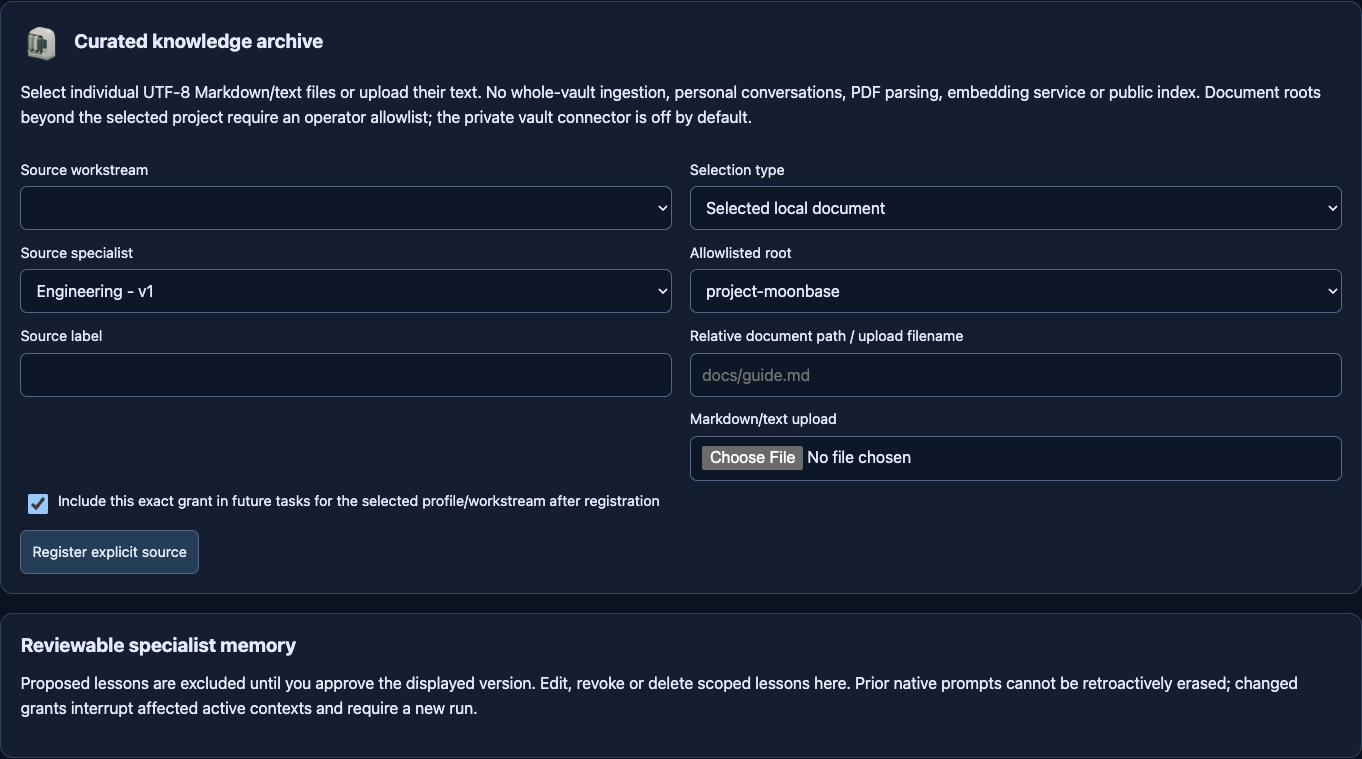
Changed, missing, refreshed or revoked sources invalidate affected active context. Previously sent native prompts cannot be erased, so changed grants require a new explicitly approved run instead of silent context substitution.
Memory follows a separate owner review:
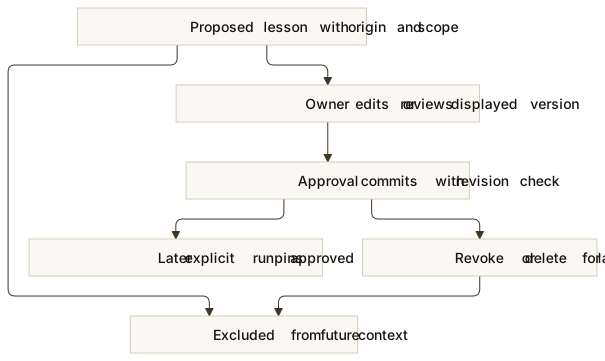
The approval must commit before a later snapshot. A pending UI request is not approval, and an old queued run retains its earlier pins. Approved lessons carry profile/workstream scope, version/hash and originating-run provenance. They are not global-vault edits, provider memory adoption or model fine-tuning.
9. Outcomes, verification and usage
Completion produces a reviewable outcome, not automatic acceptance. Receipts bind artifacts, changed files, captured diff, branch/base/head, provider/native session and profile/context provenance. Verification records the actual selected command, exit, output and workspace state. Owner acceptance rechecks current artifact/workspace bytes, so stale evidence is not a passing review.
Verification presets are fixed choices such as diff whitespace checks, Node tests and npm test/build/typecheck. The workstream selects which are available, and execution requires exact approval. A project test can execute project code. Its sanitized environment/private home is a containment measure, not an OS sandbox; untrusted project code remains a real risk.
Literal evaluation examples check specified phrases/citations. They do not certify factual correctness, teaching quality or complete test coverage. Whitespace-only verification cannot be labeled a full project pass.
Usage stores the units and coverage reported by the provider, which may include tokens, USD estimates or nano-AIU. Missing usage is unavailable, not zero. Account quota and premium multipliers are not per-run dollars or credits. The implementation does not invent conversions or a hard spending guarantee. Legacy mission billing is separate from SDK-run accounting.
Opaque Copilot usage identifiers are normalized using a complete session-bound identity digest, not truncation. Unsafe/malformed accounting refuses before effects instead of manufacturing a valid-looking receipt.
Turn and active-time allowances are operational bounds. A client-observed turn Stop is not a provider pre-call charge guarantee. Owner waits and cleanup states must remain visible when interpreting those limits.
10. Persistence, observation and failure semantics
New bounded owner-only records occupy a separate private Workbench subtree. Ordered events rotate into immutable hash-verified checkpoints; artifacts remain immutable. Atomic writes, physical path checks, current authority, revision checks and content/mode compare-and-swap protect state changes.
Bounds, I/O, authority or CAS failures are explicit and can quarantine dispatch. They do not delete history or substitute a successful default. Absent state is established through a guarded physical-parent lookup; lookup errors or linked roots do not become empty state.
Browser reconnect receives current snapshots without replaying task starts or tool decisions. Session and RBAC are rechecked on stream events and heartbeats. A replaced EventSource can be intentionally cancelled by browser lifecycle reconnect; observation tooling must distinguish that identity-bound replacement from a genuine transport failure.
App shutdown closes owned SDK transports/verifiers and retains interrupted or unresolved-cleanup records. Verifier termination targets an owned child, not a recycled process group. Unconfirmed cleanup remains uncertainty; a late close cannot erase it. Abrupt-restart reattach is not presumed safe, and no paid replacement is automatically submitted.
11. Optional assets and preserved foundation
Moonbase retains the MIT-licensed Agent Office foundation, real PTYs, project/worktree/queue machinery and collaboration surfaces. Original Blender residents and laboratory props remain runtime models, not generated concept images mislabeled as application assets.
The new task console, knowledge archive and review station have authored screen mounts, bounds, named nodes and material contracts. Their icons can load independently in the 2D Workbench. Habitat projections use current owned work/sources/decisions, and unavailable freshness is not rendered as activity. Workbench/login initialization never waits for GLB preload.
12. History-safe deployment and scoped maintenance
The completed configuration operation kept the application source unchanged, used a separately reviewed immutable helper and preserved 570 protected file byte/mode/ownership/size fingerprints, including retained mission/auth/floor state. Its complete originals were captured before any close. The existing v1 mission and completed records were not reset or migrated for convenience.
Protected same-source maintenance requires a fresh complete one-use admission, with a maximum 120-second wall/monotonic validity through final readiness and journal publication. The sequence is one owned close before configuration CAS, natural exit of the exact empty host resources, closed-state checks, the captured configuration/plist delta, one bootstrap and final source/controller/history/resource/expiry checks.
Failed journals and consumed tickets are retained. There is no reset, automatic retry, blind bootstrap or automatic rollback. An after-Stop failure requires prompt exact-state reporting and separately authorized recovery. A source merge, a prepared archive or a health 200 is not admission.
The merged moonbase-operation-v1 correction adds explicit scope binding to
capture, archive, OS proof, independent review, consumed ticket and guarded
apply. It rechecks live, unloading, closed, pre-CAS, between-CAS,
pre-bootstrap and final boundaries. Legacy/default global-host-v1
behavior is unchanged.
Operation scope admits unrelated terminals only outside actual Moonbase conflicts. Owned lineage/groups, PTY claims/full descriptors, protected cwd/file readers/writers and controller/socket/TCP conflicts still refuse. Complete bounded fixed-probe evidence is privately bound and replayed through the same parsers. Names, same UID, apparent idleness or familiar parent applications are not exemptions.
This scope is not universal absence of escaped/reparented work, signed execution attestation or an in-memory JavaScript measurement. Its current supported historical bootstrap profile does not authorize the restarted AFTER-config generation. Using it in future production maintenance requires a separately reviewed supported profile and immutable helper release. Regenerating old anchors to force admission is not supported.
13. Acceptance evidence and remaining limits
| Requirement | Evidence category and result |
|---|---|
| Browser-independent server ownership | Implemented lifecycle/cleanup controls and isolated real native workflows. |
| Actual Workbench entrance | Live authenticated local HTTP, SSE and desktop 1440px/mobile 390px UI captures. |
| Versioned profiles/context | Source/control evidence; current production has four ungranted templates and no activated workstreams. |
| Native Copilot artifacts and memory | Four isolated submissions, three successful tasks, exact committed-memory follow-up. No new production model call for screenshots. |
| Native Claude | Adapter controls covered; actual activation remains permitted-auth blocked. |
| Preservation | Actual protected operation retained all 570 byte/mode records and original mission state. |
| Unrelated-terminal maintenance | Merged source and owned-neutral-terminal fixture proof; global/launchd/controller seams accurately labeled, not live deployment proof. |
| UI integrity | Actual 1440px and 390px document/client widths matched; three loaded station icons; no fabricated activity or CSP relaxation. |
Provider catalogs/authentication must be verified explicitly before new tasks. Discord delivery remains unconfigured without an owner destination. Physical phone interaction, a new Cloudflare sign-in, host reboot, sustained provider load and live execution under the new scoped-maintenance profile are not established by these captures.
The design is intentionally inspectable before it is expansive. Its next useful evaluation is an explicitly granted project workload with real acceptance criteria, not more identities animated as busy.
References
- Moonbase project, Workbench article and original Moonbase article.
- Agent Office pinned foundation and its MIT license.
- GitHub Copilot SDK, authentication and usage/billing.
- Claude Agent SDK overview and permissions.
Vendor references were reviewed on October 13, 2026. Their current documentation may evolve; the version table records Moonbase’s reviewed implementation pins.