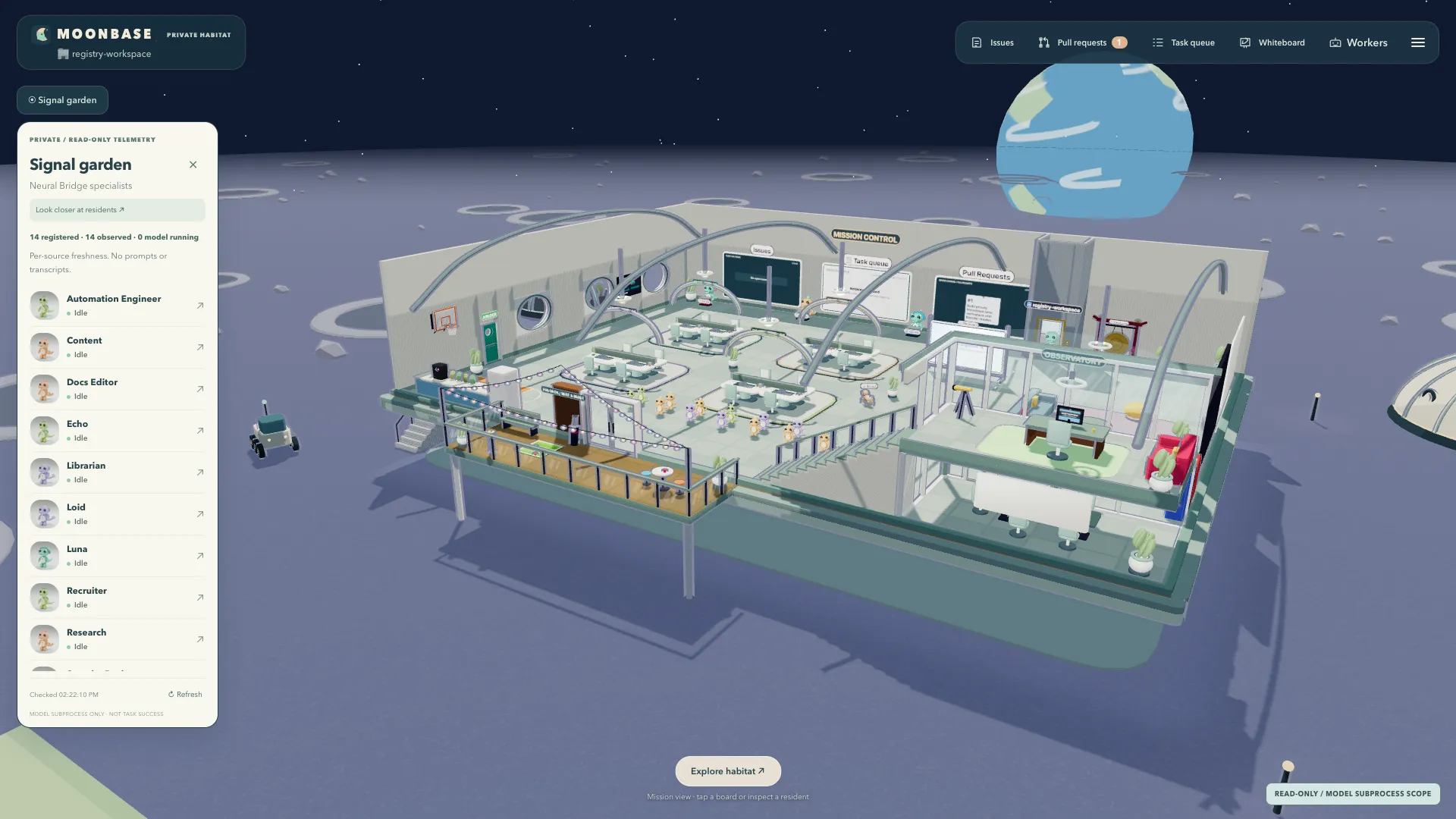
Moonbase started with a simple idea: give the agents behind Neural Bridge a place I could walk around.
Not a process list with cartoon icons. A small lunar research station, with original alien-dinosaur residents, working terminals, project boards, and a clear distinction between an agent that is busy and one I have not actually observed.
The last part turned out to matter as much as the characters.
This is a private, local workspace. The source is private for now, and this article is not an invitation into the operational system. The Moonbase project page tracks the build.
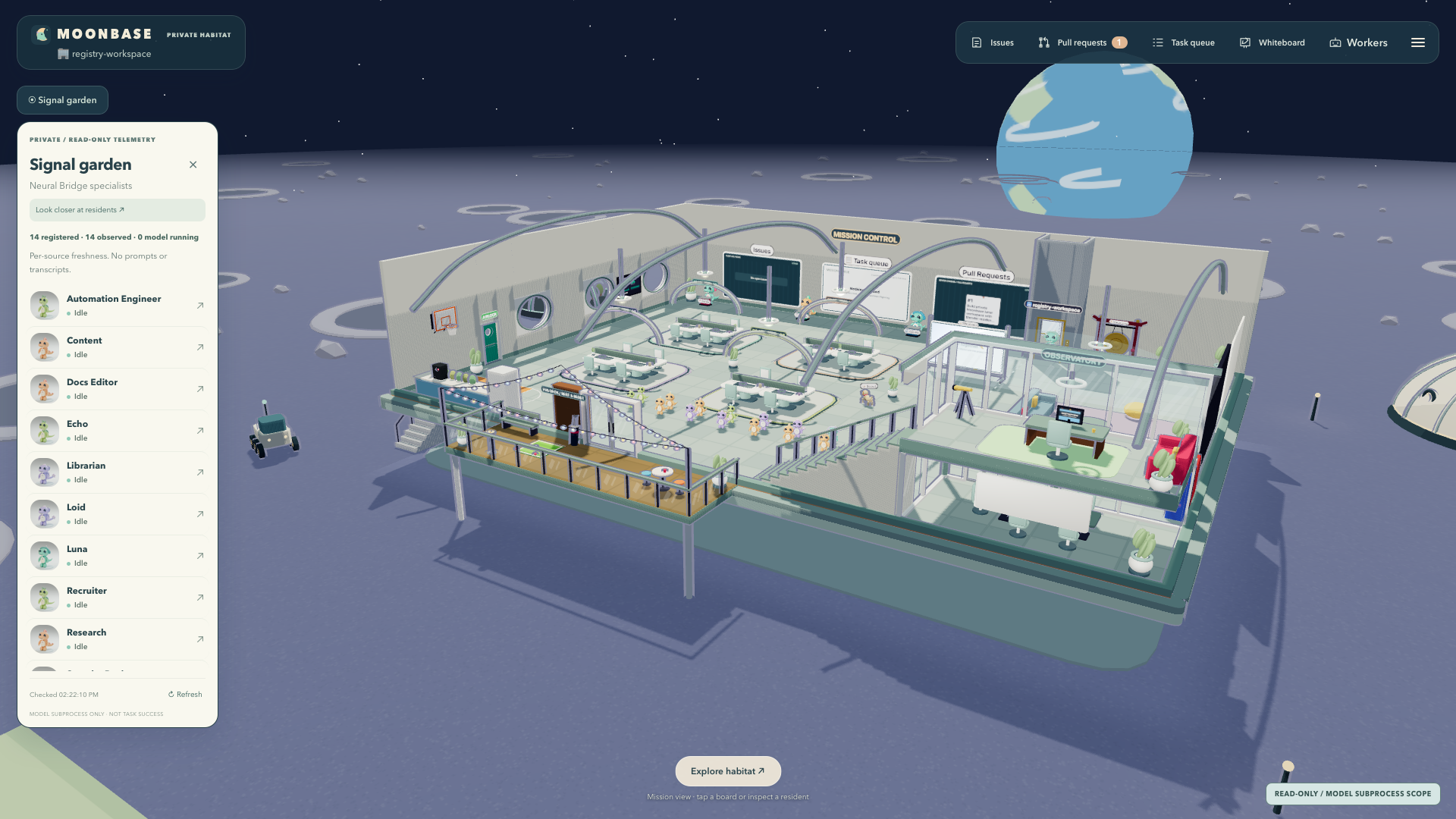
Keep the machinery, change the world
The starting point was Agent Office, by AgentSystemLabs. It is MIT-licensed, and Moonbase preserves that attribution. I pinned the starting revision rather than treating a fast-changing upstream branch as a stable specification.
Agent Office is much more than a Three.js room. It launches real coding CLIs inside pseudoterminals. A separate terminal host keeps their screens available through a server reload. A headless terminal mirror turns those screens into both interactive browser terminals and small laptop displays in the scene.
It also has project floors, worktrees, GitHub issue and pull-request boards, queues, meetings, chat, a shared whiteboard, and voice and screen-sharing paths. Rebuilding only the room would have discarded most of what made the project interesting.
Moonbase keeps that runtime. The larger visual changes happen around it: original characters, a lunar setting, cleaner equipment, quieter labels, and wayfinding that belongs to the new environment.
The laboratory now uses five original Blender-exported prop types: workstations, seats, ring lights, display frames, and seed-pod planters. They replace repeated equipment throughout the room rather than sitting in a separate showcase.
That creates a useful constraint. Moving a desk visually is not harmless if the interaction target and collision model remain where the old desk was. Replacing a worker with a static model is not a complete change if typing, walking, waiting, held objects, and cleanup stop working.
The geometry, controller, and interaction contracts have to agree.
Two kinds of resident
The most important architecture decision was not a renderer choice. It was separating managed workers from observed specialists.
Managed workers are the coding processes Moonbase launches at desks. They have real terminals, native permission prompts, and the existing queue and worktree machinery.
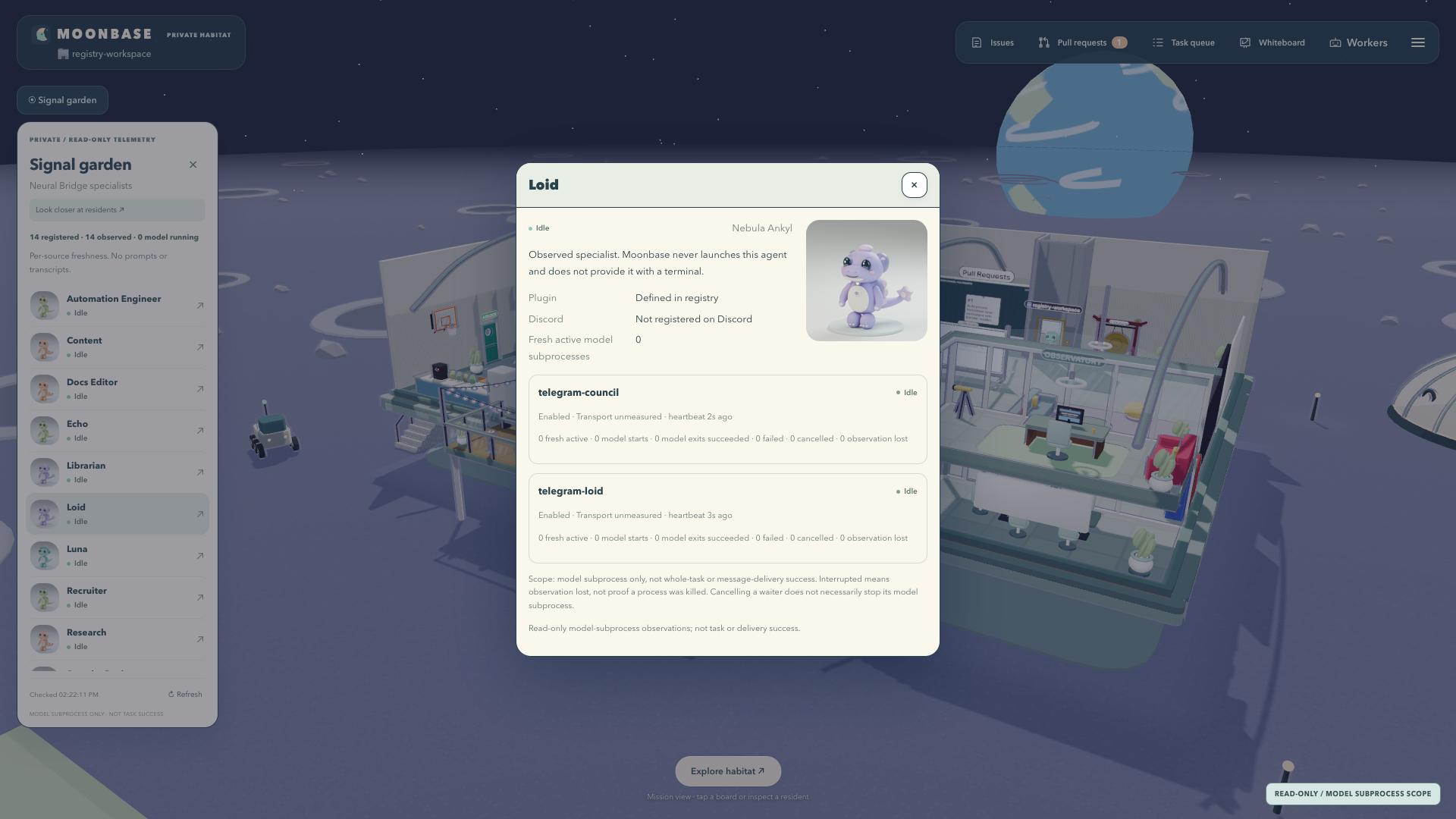
Observed specialists are the Neural Bridge agents that already run through Discord and Telegram. Showing Luna or Loid in Moonbase must not start another copy, attach an invented terminal, or give either agent new permissions.
| Resident | Source of truth | What Moonbase can claim |
|---|---|---|
| Managed coding worker | Its process, terminal, and provider lifecycle signals | The measured state of that worker |
| Observed Neural Bridge specialist | Its real definition plus optional runtime observations | Only what the observer actually measured |
| Registered but unobserved specialist | The plugin/configuration registry | The identity exists, not that it is connected or working |
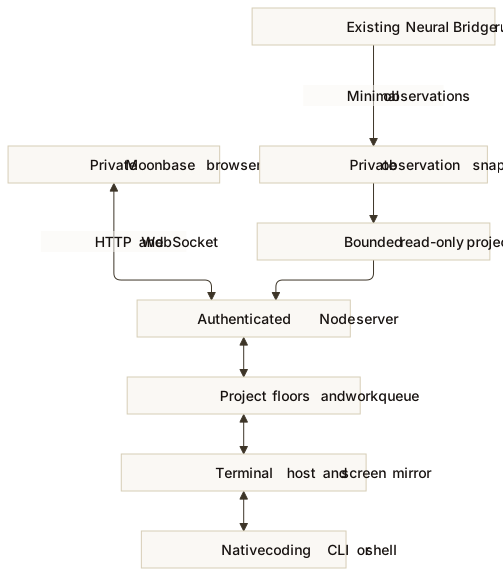
The observation path has no return arrow that dispatches work to those specialists. It is deliberately not a second orchestrator.
Blender assets with a runtime contract
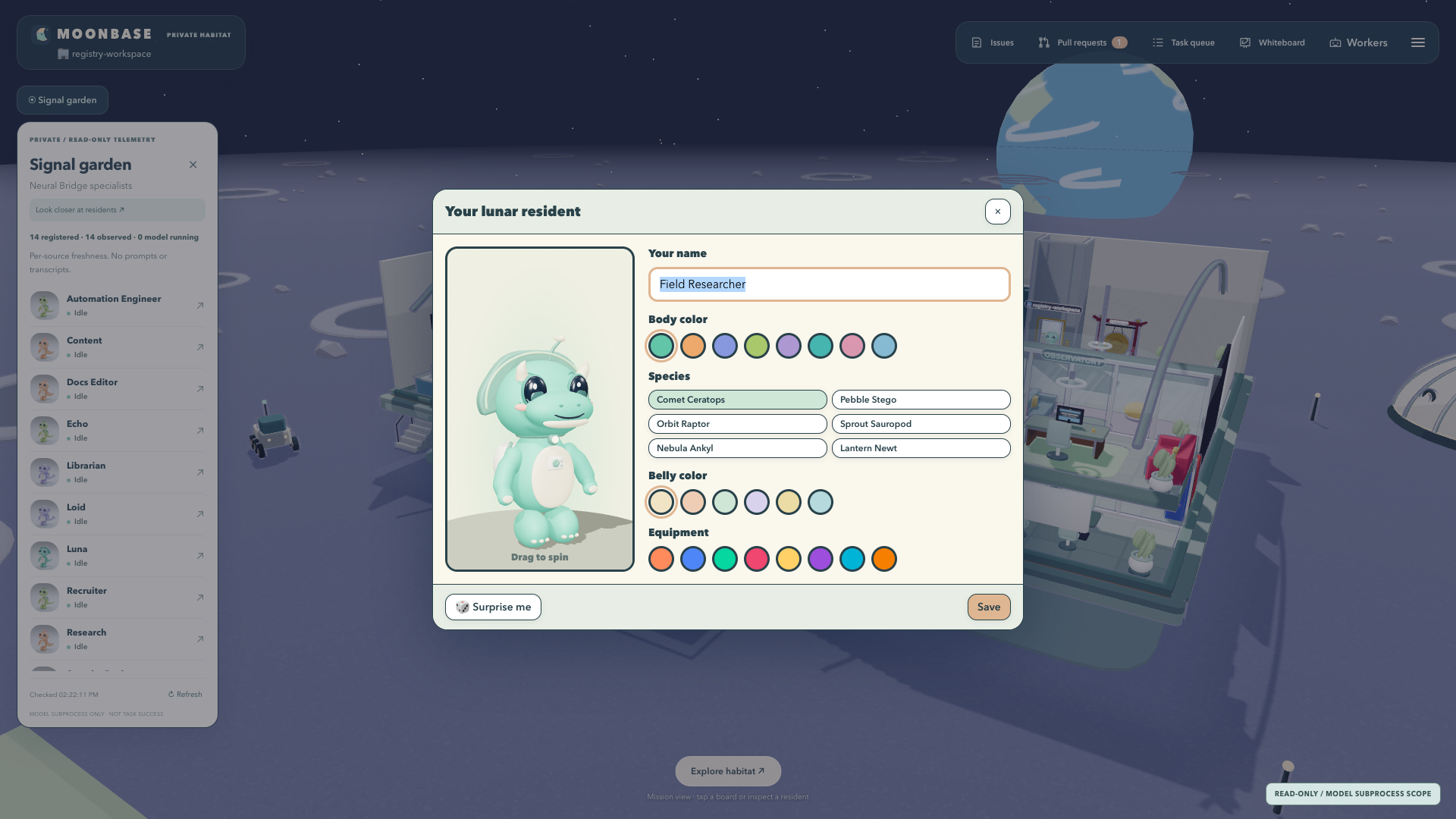
The residents are six original alien-dinosaur designs. Their frills, plates, ear fins, crests, shells, and tails make them distinguishable without needing six unrelated art styles.
The assets begin as reproducible Blender scripts and an editable .blend
scene. They export to GLB with predictable orientation, bounds, materials, and
named pivots. The browser loads those files into the existing character
controllers.
This is different from making an attractive render and then approximating it with unrelated shapes in JavaScript. The exported models are the ones the app actually draws.
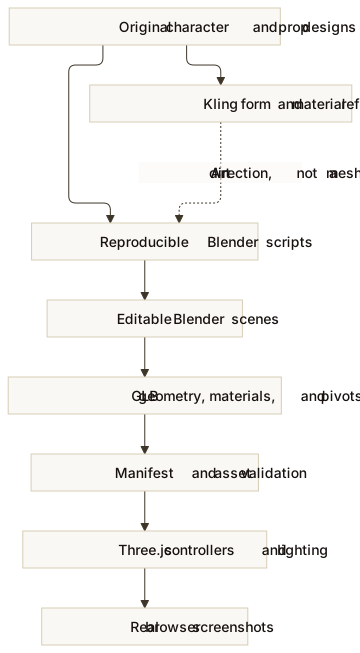
Kling helped with form and shading studies: softer transitions between body parts, more deliberate material response, and stronger contact shadows. It did not generate the runtime meshes.
One character study also omitted two of the six species. That was not a reason to delete working models or describe the output as a complete character set. I kept all six original designs and used the usable material direction across the set.
The same principle applies to the laboratory props. A concept can suggest a good rounded shell or a convincing shaded surface while getting a seat or support wrong. The implemented model still needs usable clearance, a stable footprint, and an interaction target a person can reach.
An asset manifest and binary checks help catch broken exports. They cannot tell me whether a face reads at the actual office camera distance. That still requires opening the app and looking at the result.
A registry is not a heartbeat
The real Neural Bridge registry contained fourteen plugin roles and thirteen Discord registrations. Loid is the role without a Discord registration in that configuration; his Telegram and Council paths still matter.
It would have been easy to load those names and animate everyone as working. It would also have been wrong.
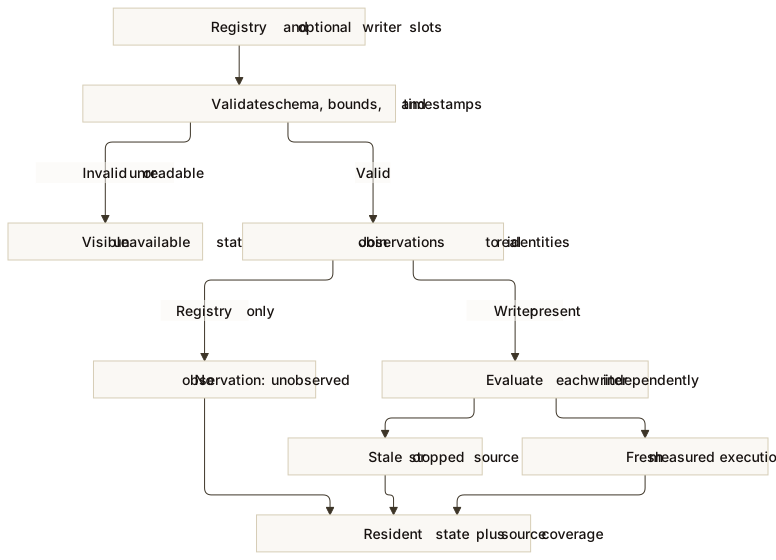
The first real integration check was intentionally less exciting: export the actual registry without starting a model or bot, load it through Moonbase’s authenticated reader, and show all fourteen identities as unobserved. The result had zero runtime writers, not fourteen healthy agents.
The optional observer uses a versioned local JSON snapshot. Each runtime owns its own source slot, instance identity, heartbeat, counters, and bounded events. Writes replace the file atomically. Moonbase’s server reads and validates it, then sends a bounded projection to the browser.
The snapshot contains identities and minimal execution state. It excludes prompts, replies, conversation identifiers, transcripts, tool arguments, credentials, and private filesystem paths.
The unit of observation is a model subprocess, not a whole user task. A successful model process does not prove that a tool action succeeded or that the user received the final reply. Telegram connectivity is left unmeasured where there is no actual connection signal.
Freshness belongs to each writer
The opt-in observer emits a heartbeat every ten seconds. Moonbase treats a running source as stale when its own heartbeat is more than forty-five seconds old. Those are implementation rules; a particular rollout still needs measured observations.
The important detail is each source’s own timestamp. If Discord stops reporting but Telegram keeps writing, a new outer file timestamp cannot make Discord healthy again.
Overlapping invocations also need real accounting. One completed call must not make a specialist idle while another call is still running. Cancelling an async waiter does not necessarily stop the subprocess running in its executor thread.
Restarting the observer adds another limit: it may know that it lost an observation without knowing that the old child process died. That is why “interrupted” means observation lost, not successful completion or a verified kill.
These distinctions are less visually dramatic than a busy animation. They are more useful when deciding whether an agent actually needs attention.
A guard failure was an interface mismatch
One integration failure happened before the telemetry code could be written. The repository’s write guard expected a structured edit input with a file path. Copilot supplied a freeform patch string.
The guard crashed instead of inspecting the edit.
The fix was not to turn the guard off. It was to adapt the input: inspect every added, updated, deleted, or moved file through the same path policy, and reject mutations that could not be understood.
A standalone check was not the finish line. The coding session had to make a normal guarded edit successfully. That was the useful evidence that the compatibility repair worked where it mattered.
What the current evidence establishes
Evidence as of September 29, 2026.
The local build has exercised real GLB loading, an actual harmless shell and terminal, terminal search and changes, a paused queue flow, shared whiteboard updates between two clients, read-only authenticated GitHub board refreshes, and desktop/touch browser interaction.
The actual registry-only producer output has also passed through the strict consumer and real browser UI. Synthetic lifecycle fixtures exercise missing, malformed, stale, disconnected, stopped, overlapping, and future-timestamp cases. A visible fixture badge keeps those demonstrations separate from observed production activity.
There are limits. The inherited coding-provider paths are covered with safe test processes, not paid model conversations. Physical microphone use, cross-network screen sharing, and remote hosting have not been demonstrated by those checks. A desktop browser emulating touch is not a substitute for a physical-phone session.
The separately authorized live pilot has now reached the existing consumer. Four independent writers advanced their heartbeats across three bounded samples. Thirteen Discord connections were measured through real gateway callbacks, while Telegram connectivity stayed explicitly unmeasured. No model invocation occurred during those samples, and none was manufactured for a screenshot.
The first activation used a reversible login-session setting. The durable follow-up now stores the opt-in in an ignored, private local configuration file. After restarting the existing services with that temporary setting removed, all four sources independently advanced again. The normal updater was restored, and the already-running Moonbase workspace read the fresh data without another app restart.
The existing login services read the configuration when they start. That is the basis for persistence across logout and reboot; I did not log out or reboot the machine as part of this release. A fresh clone still needs its own private configuration. The screenshots show the genuine earlier live-pilot state, not a manufactured busy scene.
A green code check alone would not have established those runtime facts. Likewise, a fresh observer heartbeat is not evidence that a model completed a user task.
A website address is a separate boundary
Moonbase could eventually have a private hostname alongside neural-bridge.dev. That does not mean attaching real terminals to a public demo.
The current server depends on persistent local processes and working trees. A separate execution host with an identity-gated route is a more direct fit than treating it as another static page in the blog.
For now, the useful result is the private workspace itself: a coherent small world around real tools, with original residents and a status model that admits what it does not know.
Attribution
Moonbase is derived from Agent Office by AgentSystemLabs, under the MIT license. The original copyright and permission notice are retained in the implementation. The data-flow diagrams are Mermaid sources rendered to static light and dark SVGs, so reading them does not require a client-side diagram runtime.