When I first published Don’t answer the regulator from a blank page, Bellwether solved one specific, high-risk problem: matching an incoming supervisory Request for Information (RFI) against a library of previously approved answers, then running a fail-closed temporal staleness guardrail on an independent model family before a human reviewer could approve reuse.
The core math held up well. Across the 69-case GShoe staleness regression suite (clean, adversarial, and borderline sets), the guardrail caught 97.2% of stale claims at a 3.1% false-fresh rate and 94.6% flag precision. Alongside it, I had designed an 18-case independence-discounted trust model (src/data_hub/trust.py) so that three internal systems syncing from the same upstream HRIS or CMDB record would count as one observation rather than three independent witnesses.
Yet when I stepped back this week to run a full information-systems audit of Bellwether and use it against realistic multi-regime workloads, five structural problems stood out immediately:
- Identity drift with its sibling project: Bellwether still carried leftover artifacts from an earlier fork, including a 4,519-line Phaser pixel office and marketing-brochure page headers (
168pxstock-photo banners) that pushed the actual compliance tools below the fold. - Token and latency waste: Every pipeline call defaulted to the primary authoring model unless manually overridden, repeated ONNX MiniLM-L6-v2 embeddings were recomputed on every stage, and
EXACTlibrary matches that had already cleared the independent staleness judge were running a redundant second LLM freshness pass. - Single-question demo vs. 40-question engagement reality: Real supervisory inquiries from the Bank of England, the European Banking Authority, or South Korea’s MSIT and KISA do not arrive one sentence at a time. They arrive as 20-to-50 question spreadsheets requiring entity scoping, live incident-path screening, four-route triage, owner assignment, inline claim repair, and an auditable export package.
- An orphaned Data Hub and broken write-back loop: The independence-discounted trust math in
src/data_hub/trust.pyhad zero imports in the FastAPI server or the staleness guardrail. Meanwhile, narratives drafted in/narrativeand/draftinghad no button to promote approved answers back intorfi_response_library. - Three-framework hardcoding: Adding a fourth regime, specifically South Korea’s Act on Promotion of Information and Communications Network Utilization and Information Protection (Korea Network Act), exposed hardcoded
["DORA", "UK_CTP", "NIS2"]arrays across the narrative, voice drafting, control mapping, and history workbenches.
This post walks through the full system audit, the token and speed optimizations, the UX overhaul into dedicated User and Admin views, the procedural 3D Blender regulation emblems, and the three-phase product roadmap we executed to ship Bellwether v3.0.
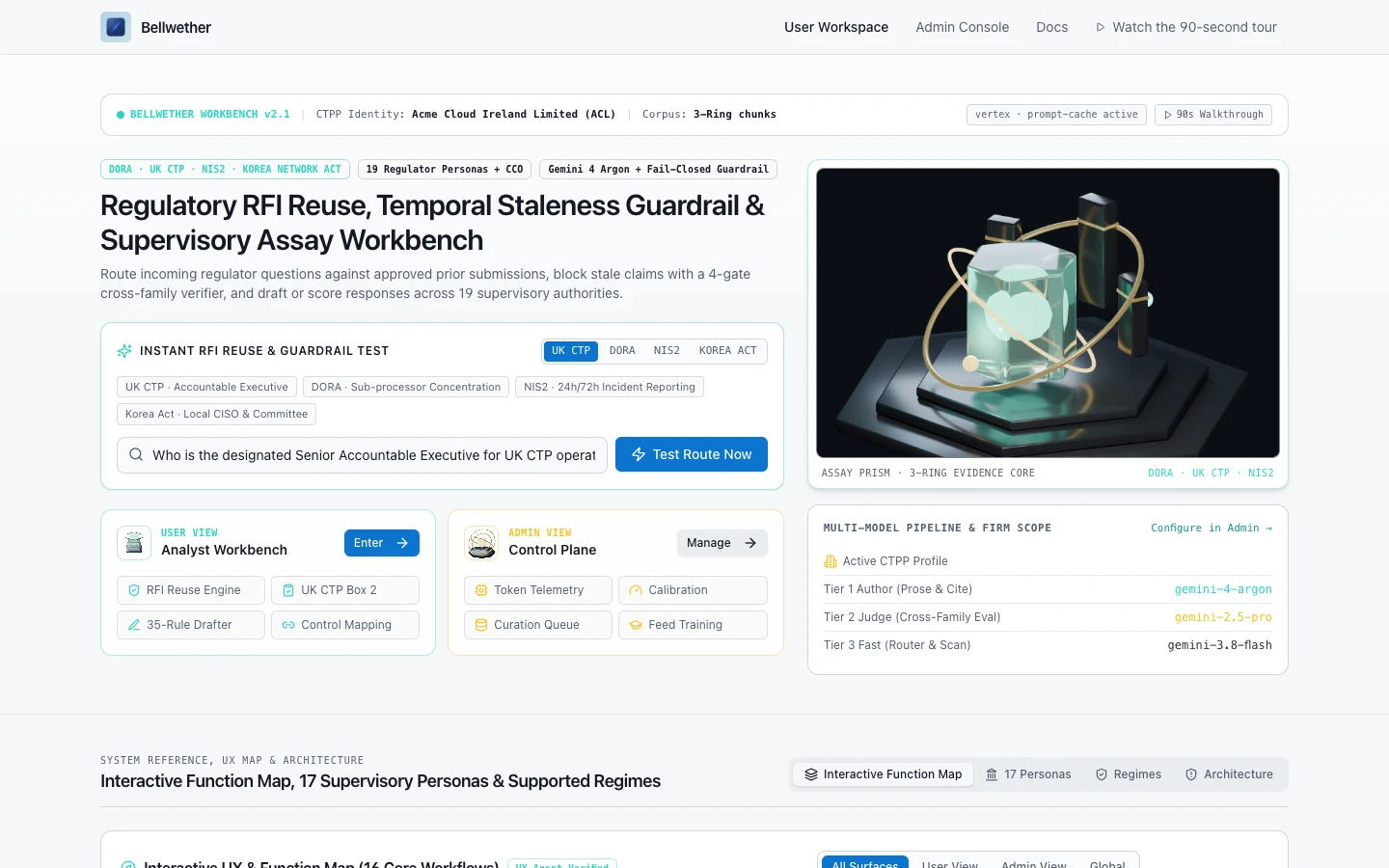
Part 1: The Information System Audit and Token Efficiency Overhaul
Drawing a Hard Line Between Bellwether and Touchstone
The first step of the audit was clarifying what Bellwether is and what it is not. My sibling project, Touchstone, is an adversarial multi-regulator examination simulator built around a desktop arena. Bellwether is the Regulatory RFI Reuse, Fail-Closed Temporal Staleness Guardrail, Semantic Data Hub, and Supervisory Submission Workbench for Critical Third Party Providers (CTPPs).
In Bellwether, regulator personas (now 19 authorities across DORA, UK CTP, NIS2, and the Korea Network Act, plus a Chief Compliance Officer synthesizer) exist strictly as a post-reuse sufficiency rubric and statutory crosswalk check. Removing every leftover Phaser pixel-office bundle and legacy reference stripped thousands of lines of dead weight and focused the interface on evidence-grounded work.
Multi-Model Role Routing, Gemini 4 Argon, and Latency Tuning
Auditing the LLM call graph revealed that mechanical tasks (document classification, RSS feed filtering, chunk titling, and horizon scans) were sharing the same flagship model configuration as long-form regulatory authoring. Worse, when our primary Cloud Run region (us-east5) hit a zero-quota ceiling on Vertex partner models, background refreshes failed unless the provider stack could route cleanly across model families.
We rebuilt config/models.json and src/models/config.py around explicit pipeline roles (AIConfig.for_role(role)) and connected Bellwether to Gemini 4 Argon (google/gemini-4-argon) on Vertex AI’s global OpenAI-compatible endpoint alongside Claude 5.5 (claude-opus-5-5, claude-sonnet-5-5, claude-haiku-5-5) on the direct Anthropic API:
| Pipeline Role | Responsibility | Vertex AI Global Stack (argon_vertex) | Anthropic Direct Stack (claude_5_5_anthropic) | Why It Matters |
|---|---|---|---|---|
author | Regulator-facing prose, partial/fresh RFI assembly, narrative rewrite | gemini-4-argon | claude-opus-5-5 | Reserves frontier reasoning for substantive legal and technical drafting. |
judge | Cross-family staleness re-grounding & answer quality verification | gemini-2.5-pro | gemini-2.5-pro | Enforces independence_ok() so no model family ever grades its own freshness. |
eval | 19-persona sufficiency scoring, CCO synthesis, anchor critiques | gemini-3.1-pro-preview | claude-sonnet-5-5 | High-throughput parallel rubric evaluation across 19 supervisory charters. |
fast | Corpus classification, chunk titling, RSS filtering, non-escalated checks | gemini-3.8-flash | claude-haiku-5-5 | Cuts cost and latency by 80%+ on high-volume mechanical classification. |
scan | NIS2 transposition refresh & regulatory horizon delta extraction | gemini-3.8-flash | claude-sonnet-5-5 | Fast structured JSON extraction over 30 EU/EEA jurisdictions. |
Alongside role routing, we shipped five concrete speed and token optimizations:
- Ephemeral Prompt Caching (
BELLWETHER_PROMPT_CACHE=1): System prompts of1,024characters or more (such as the 35-principle voice charter and 19 regulator charters) automatically attachcache_control: {"type": "ephemeral"}inside_CompletionsShim._build_kwargs(), cutting repeated input token costs by up to 90%. - Single-Pass
EXACTReuse Deduplication: Insrc/rfi_reuse/router.py(_exact()), when the temporal staleness guardrail escalates to the independent judge and confirms zero stale claims (verdict.reusable is True and verdict.escalated is True and not verdict.check_failed), the router now skips a duplicate second LLM freshness pass, cuttingEXACTmatch LLM calls in half while preserving fail-closed behavior. - In-Memory ONNX Embedding LRU Cache:
EmbeddingClientinsrc/corpus/embeddings.pynow caches the 512 most recent 384-dimall-MiniLM-L6-v2query embeddings in memory so repeated lookups of the same RFI question across routing, staleness checking, and corpus retrieval execute in under0.01ms. - Vertex Gemini Thinking-Token Budget Tuning: Benchmarking Vertex AI’s OpenAI-compatible Gemini endpoint revealed that Gemini 3.x and 4.x count internal thinking tokens against
max_tokensand default to high thinking latency (~21s). Settingreasoning_effort="low"by default with+1,024thinking-token headroom reduced structured JSON completion latency from21.68sto1.24songemini-3.8-flashand2.35songemini-4-argonwhile preventing mid-JSON truncation. - 1-Click Runtime Model Stack & Firm Profile Switchers: The Admin Console (
/admin) now exposes live token, cache-hit, and latency telemetry per role (GET /api/models) and lets operators switch between the Gemini 4 Argon, Claude 5.5, and Gemini 3.1 Pro stacks or switch the active CTPP firm profile (POST /api/firm) at runtime without redeploying.
Part 2: UX Redesign, User vs. Admin Split, and 3D Blender Regulation Emblems
Designing for Daily Use Instead of Brochure Scroll
A compliance workbench should feel like an instrument panel, not a marketing site. We ran a dedicated UX interaction audit across all 16 user workflows (UxFunctionMap.tsx, embedded interactively on / and /admin) and restructured the application into two explicit modes switchable from the persistent top header and sidebar:
- User View (
WorkspaceMode): Built for regulatory counsel, Local CISOs, and GRC analysts. Houses the Analyst Workbench (/workspace), Regime Hubs (/dora,/uk-ctp,/nis2,/f/korea_network_act), 6-Stage Narrative Engine (/narrative), Firm Voice Drafter (/drafting), Scope & Control Matrix (/mapping), and Verified Ledger (/history). - Admin View (
AdminMode): Built for platform engineers, knowledge curators, and calibration owners. Houses the Admin Console (/admin), Staleness & Data Hub Trust Calibration (/rfi-calibration), Corpus & Contradiction Scanner (/corpus,/corpus/curation), Regulator Charter & Feed Training Room (/regulators,/training), and 4-Step Dynamic Regulation Onboarding Wizard (/onboard).
We also replaced the 168px stock-photo PageHeader banners across every internal route with a compact py-3.5 px-6 workbench toolbar, surfacing breadcrumbs, status badges, and action buttons while reclaiming vertical viewport space for data tables and editors.
Replacing Circular “Seal” Medallions with Procedural 3D Blender Sculptures
Previously, the three built-in regimes used circular navy seal medallions (rounded-full) while dynamically onboarded regimes fell back to a generic flat Lucide Landmark icon. Seal medallions looked dated and visually flattened every framework into the same circle.
We wrote a headless Blender 5.2 LTS procedural studio script (scripts/render_regulation_icons.py) using Cycles with Apple Metal GPU hardware raytracing, OpenImageDenoise, studio area lighting, and transparent RGBA film (film_transparent=True) to render bespoke 3D architectural emblems for every regime:
- DORA (
fw-dora.png): Interlocking cobalt glass and brushed gold hexagonal resilience shield. - UK CTP (
fw-ukctp.png): Crimson glass and platinum 3-pillar systemic stability triad representing joint BoE, PRA, and FCA oversight. - NIS2 (
fw-nis2.png): Emerald glass geodesic cyber-mesh node sphere with gold interconnects. - Korea Network Act (
fw-korea-network-act.png): Cyan and crimson interlocking sovereign gateway torus and dual-core governance monolith. - EU AI Act (
fw-eu-ai-act.png): Violet glass neural polyhedron suspended inside precision orbital rings. - EU Cyber Resilience Act (
fw-cra.png): Amber and gunmetal hardware microchip fortress with a verification core.
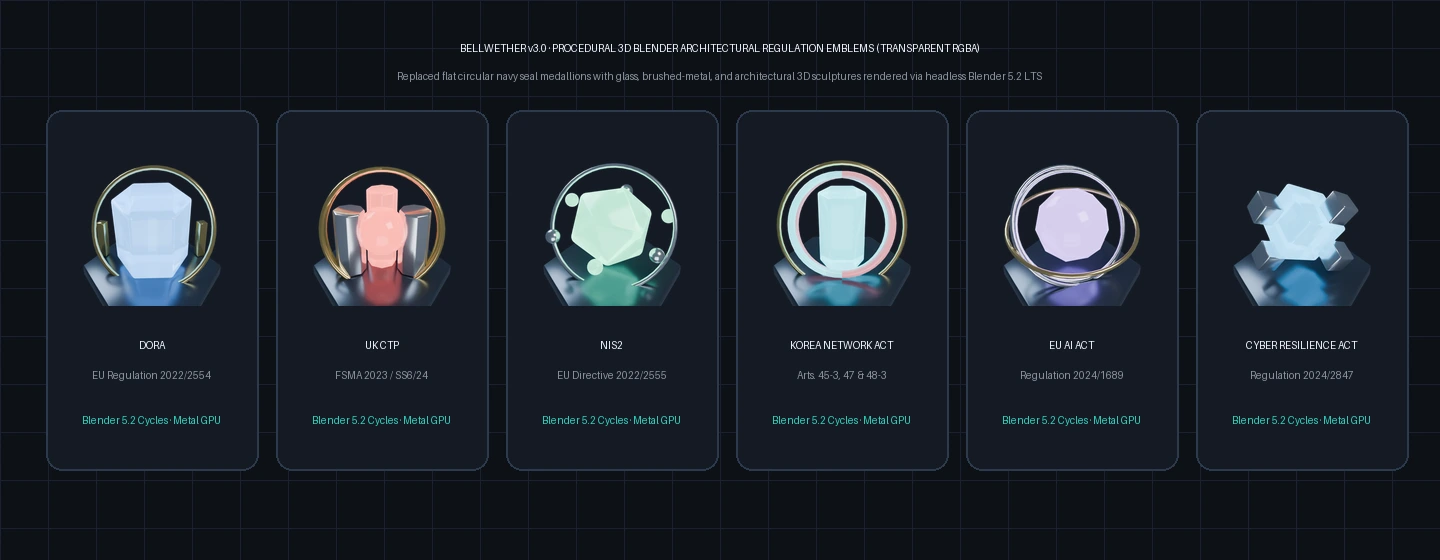
FrameworkEmblem.tsx lets each sculpture’s silhouette anchor the sidebar, headers, and regime cards. Open full size.Part 3: Senior PM Product Review and the Three-Phase v3.0 Roadmap
With the foundation cleaned up, we ran a Principal Product & Program Manager review (senior-pm-product-strategist) comparing Bellwether’s codebase against the actual day-to-day mechanics of running multi-jurisdictional regulatory engagements.
Where the Loop Broke in v2.1
The PM review identified five “last-mile workflow gaps” that prevented Bellwether from acting as a closed-loop system of record:
- Gap 1 - Stateless Single-Question Triage vs. Multi-Question Engagement Packs: Analysts could paste one question at a time, but could not upload a 30-question regulator questionnaire, classify items into governance routes (
Route A/B/C/D), flag live incident-reporting triggers, assign owners, and export a complete package with W3C PROV lineage. - Gap 2 - Broken Write-Back (“Promote to Library”) Loop: Drafts finished in
/narrativeand/draftinghad no path back intorfi_response_library, andRfiReusePanel.tsxrendered reused answers as read-only text so a reviewer could not repair a single stale metric inline before approving. - Gap 3 - Orphaned Data Hub & Silent Corpus Contradictions:
src/data_hub/trust.pywas unwired to the API and UI, and contradictory documents inside the corpus (such as a June 2026 brief stating no UK CTP had been designated alongside the July 2026 SI 2026/777 designation brief) were never surfaced as active conflicts. - Gap 4 - Second-Class Dynamic Regimes (
KOREA_NETWORK_ACT,EU_AI_ACT,CRA): Newly onboarded regulations were missing from the framework selectors in/narrative,/drafting,/mapping, and/history, and the Korea Network Act hub lacked its statutory Article 45-3 Local Security Committee and subsidiary-separation workflows. - Gap 5 - Single-Regime Silos for Cross-Regime Obligations: Updating a canonical fact (like Tier-1 RTO or CISO identity) did not automatically flag dependent RFI answers across other regimes, and analysts had no side-by-side matrix comparing incident reporting clocks across DORA (4h), UK CTP (immediate), NIS2 (24h), and the Korea Network Act (24h KISA + 72h PIPC).
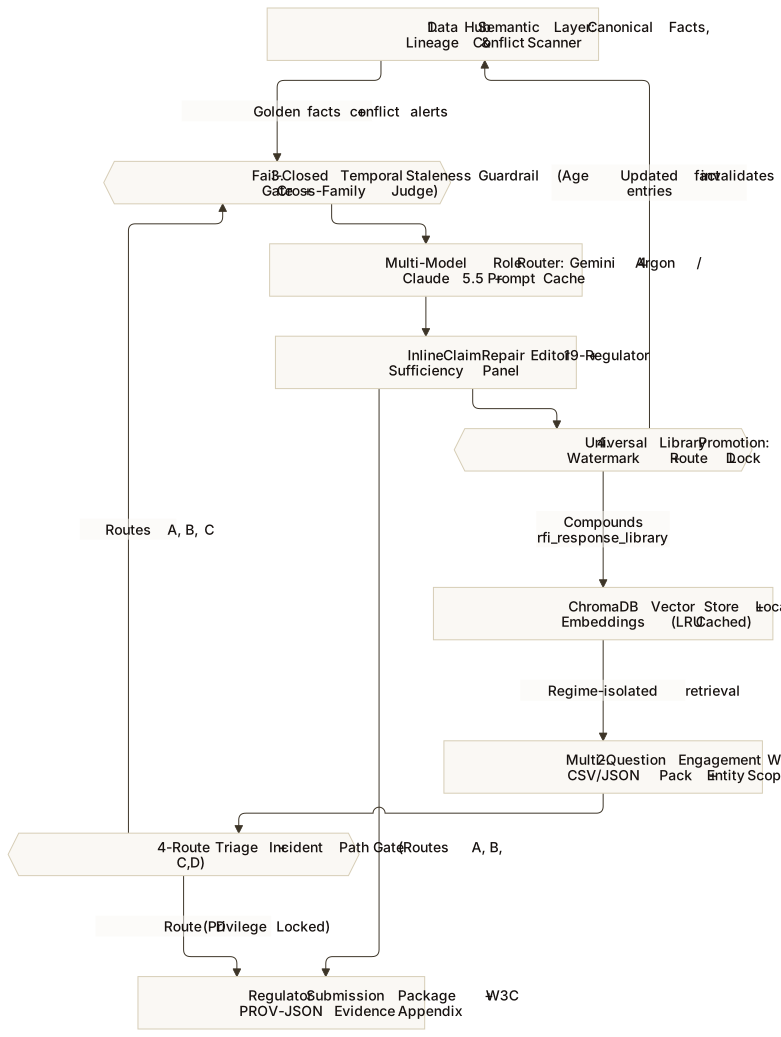
The Explicit Anti-Roadmap (What We Chose Not to Build)
Equally important was defining what Bellwether must not build:
- No theatrical 2D/3D offices or free-form regulator debates: That is Touchstone’s domain.
- No live read/write ETL into production HRIS (Workday) or CMDB (ServiceNow) databases: Direct HRIS/CMDB connectors create unnecessary PII and data-residency blast radius; Bellwether ingests schema-contracted read-only snapshots with
derived_fromlineage metadata. - No silent auto-regeneration or auto-submission of stale answers: Regenerated text always lands in a human diff-and-confirm editor (
confirmed_accurate: true). - No indexing of Route D (Privileged Legal / CELA) deliberations into the shared vector store: Questions involving statutory scope disputes, administrative fines, or enforcement exposure are privilege-locked (
422on/api/rfi-reuse/library/add) and logged as metadata-only.
The Phased Build Plan (RICE Prioritized)
We organized the six feature bets into three sequential phases and built all three end-to-end:
| Phase | Feature Bet | RICE | Key Backend & Frontend Deliverables |
|---|---|---|---|
| Phase 1A | Dynamic Framework Propagation | 79 | Extended src/narrative/catalogue.py, harmonizer.py, and src/mss.py with full Korea Network Act domains, anchor regulators (MSIT, KISA, KCC_PIPC), and obligation catalogues; wired useFrameworks() across NarrativePage, DraftingPage, MappingPage, and HistoryPage. |
| Phase 1B | Inline Claim Repair & Universal Library Promotion | 92 | Added inline markdown editing and 1-click regenerated draft application to RfiReusePanel.tsx; built PromoteToLibraryCard.tsx across Narrative and Voice Drafting with Evidence Ring (Ring 1/2/3) watermarks, volatility TTLs, entity scope, and the Route D Privilege Lock. |
| Phase 1C | Data Hub Semantic Layer & Corpus Conflict Scanner | 85 | Built src/data_hub/conflicts.py, src/server/data_hub_routes.py, and DataHubExplorer.tsx on /rfi-calibration and /corpus; wired staleness.py (_source_of_truth) to inject canonical golden facts into the cross-family judge; linked fact updates to automatic ResponseLibrary.flag_stale() invalidation. |
| Phase 2A | Multi-Question Engagement & 4-Route Triage Workbench | 88 | Built src/rfi_reuse/engagement.py and RfiEngagementWorkbench.tsx on every regime hub (?tab=engagement), supporting multi-question packs, CSV/JSON upload, Incident Path alerts, Routes A/B/C/D classification, inline editing, and W3C PROV-JSON Evidence Appendix export. |
| Phase 2B | Korea Network Act (Art. 45-3) Committee & Subsidiary Pack | 82 | Built src/korea/governance.py, src/server/korea_routes.py, and KoreaCommitteePortal.tsx on /f/korea_network_act with a Subsidiary Entity Switcher, 8-Topic Art. 45-3 Committee & RACI Tracker, Two-Way Policy Change Ledger, and “Entity Answers; Corp Supplies Evidence” Voice Validator. |
| Phase 3 | Cross-Regime Obligation Comparator & Statutory Clocks | 74 | Built CrossRegimeMatrix.tsx on /mapping?tab=cross-regime comparing DORA, UK_CTP, NIS2, and KOREA_NETWORK_ACT across 5 core domains, and added the Active Statutory Clocks & Conflicts strip to /workspace. |
Part 4: Deep Dive into the Shipped v3.0 Capabilities
1. The Regulatory Semantic Layer (Data Hub) and Corpus Contradiction Scanner (Phase 1)
In our earlier UK CTP work, we discovered a subtle failure mode: the knowledge corpus simultaneously held a June 2026 research brief stating that “no UK CTP has been designated yet” and a July 2026 brief recording that HM Treasury made SI 2026/777 on 10 July 2026 (in force 13 July 2026). Depending on how a question was phrased, vector retrieval could surface either chunk.
In Bellwether v3.0, src/data_hub/conflicts.py and DataHubExplorer.tsx make the Regulatory Semantic Layer first-class live software:
- Live Trust Scoring with Root-Ancestor Deduplication: Every canonical golden fact (
GF-01throughGF-09, plus the 18-case GShoe benchmark) is scored viatrust = freshness * (0.45 * authority + 0.30 * corroboration_eff + 0.25 * verification), wherecorroboration_eff = 1 - 0.5^(n_eff - 1)andn_effcollapses any sources sharing aderived_fromroot ancestor into a single independent observation. - Direct Injection into the Staleness Judge: When
assess_staleness()runs in production (src/rfi_reuse/staleness.py),_source_of_truth()now prepends the regime’s green and amber canonical golden facts directly above the retrieved ChromaDB excerpts. - Cross-Regime Staleness Propagation: When an analyst updates a canonical fact’s value in the UI (
POST /api/data-hub/verify-fact), Bellwether automatically callsResponseLibrary.flag_stale()for that regime and rule reference, immediately marking dependent historical answers for re-verification.
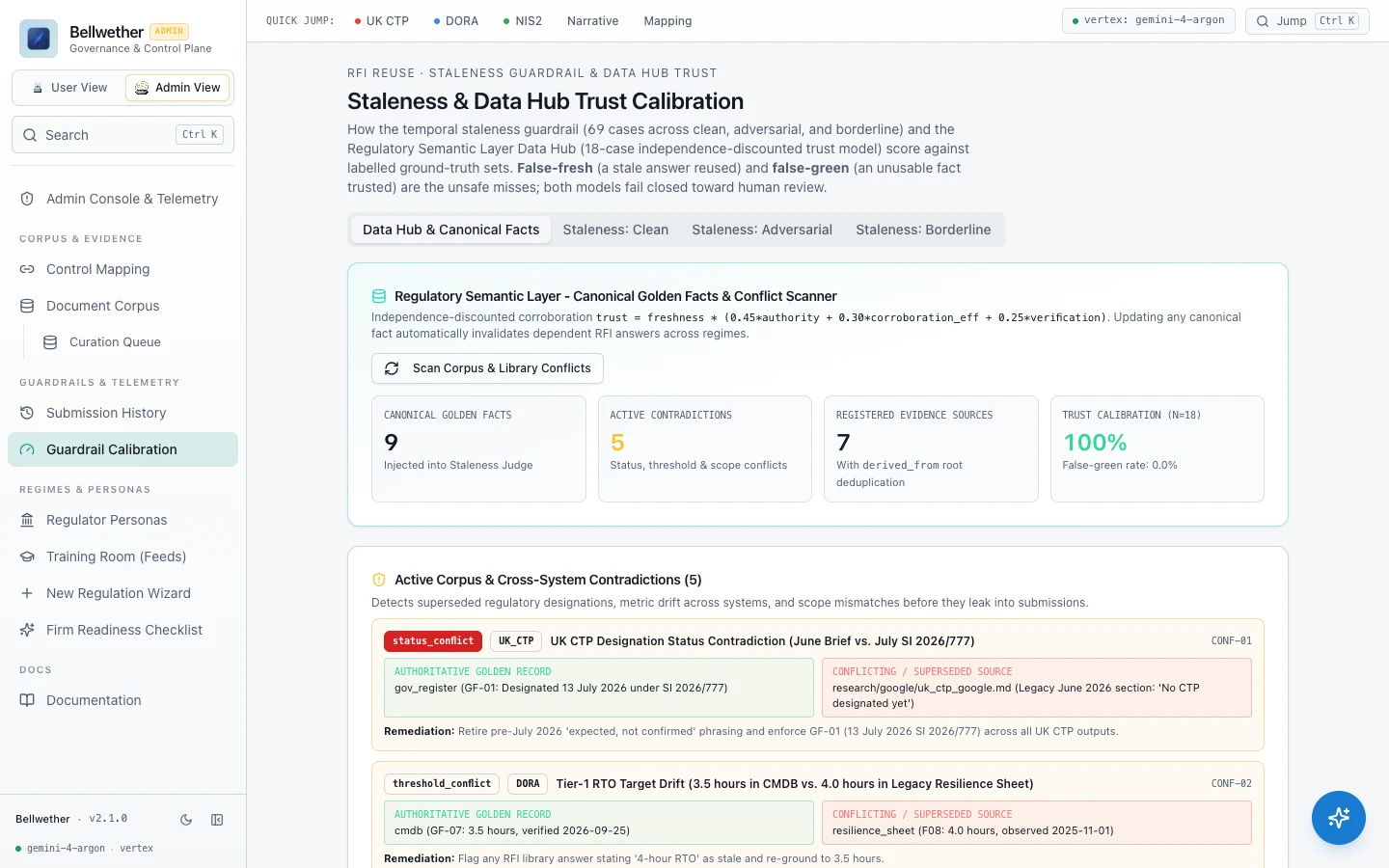
/rfi-calibration (also embedded in /corpus). It surfaces active status_conflict, threshold_conflict, and scope_conflict contradictions alongside live trust breakdowns and derived_from root-ancestor lineage. Open full size.2. Multi-Question Engagement Workbench, 4-Route Triage, and the Korea Art. 45-3 Portal (Phase 2)
When a global cloud or ICT provider operates through local subsidiaries in jurisdictions like South Korea, regulatory compliance is governed by three operational rules:
- Principle 1 (“The entity answers; Corp supplies evidence”): A local Korean subsidiary cannot reply to MSIT or KISA by saying “Global headquarters handles this.” The covered local entity owns the statutory duty and answers in its own voice, attaching global corporate engineering controls strictly as supporting evidence.
- Principle 2 (“One log per entity”): A commercial sales and licensing subsidiary has a different statutory profile from a data center operating subsidiary (Information and Communications Service Provider, or ICSP). Their RFI logs, risk registers, and Local CISO filings must remain strictly separated.
- Principle 3 (Four-Route Triage + Route D Privilege Lock): Incoming questions split into four distinct operational routes:
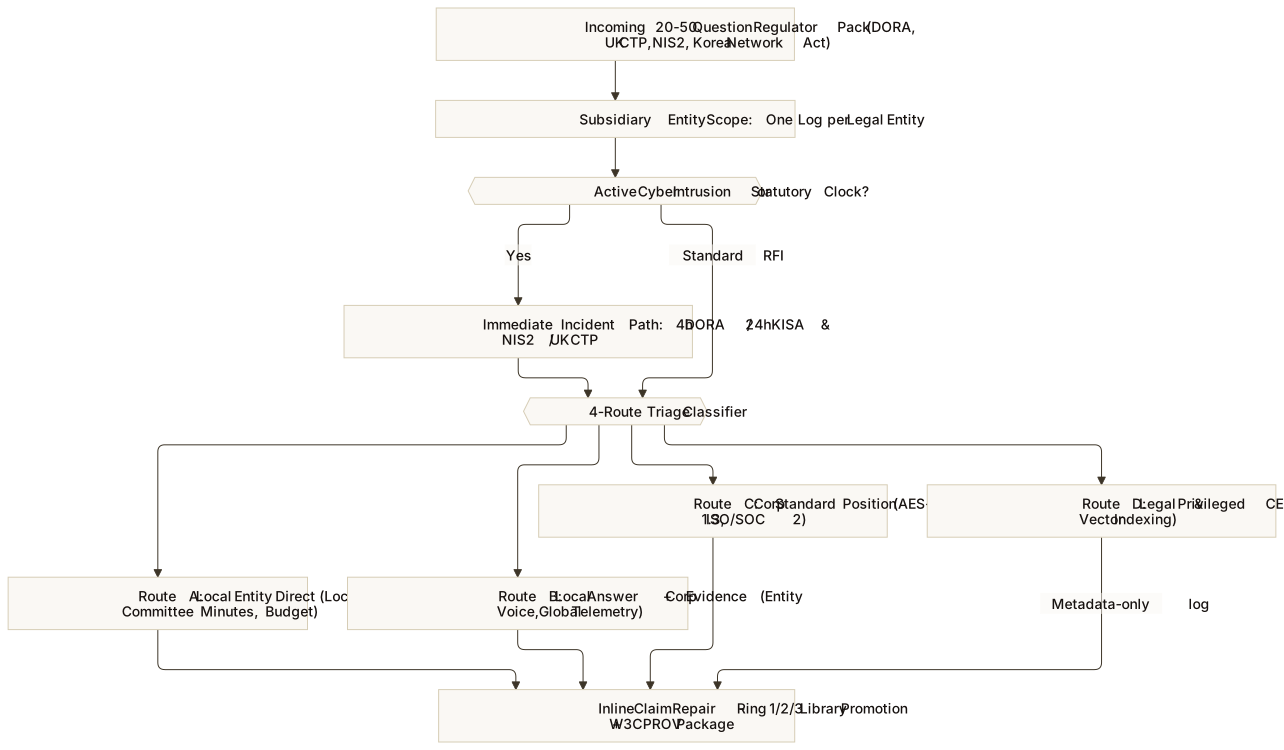
src/rfi_reuse/engagement.py. Route D items (statutory disputes, administrative fines, compulsory notices) are automatically privilege-locked so legal deliberations never enter the shared vector store. Open full size in light or dark.On /f/korea_network_act, the new KoreaCommitteePortal.tsx and RfiEngagementWorkbench.tsx bring all of these mechanics into one workspace:
- Subsidiary Entity Scope Switcher: Toggles between the Commercial & Licensing Subsidiary and the Data Center Operating Subsidiary (ICSP), verifying each entity’s dedicated Local CISO (
정보보호최고책임자), Article 45-3(3) dual-role prohibition (zero concurrent non-security roles), MSIT filing status, and KISA ISMS-P/CSAP boundary. - Article 45-3(4) Local Information Security Committee Tracker: Tracks deliberation status (
approved,in_review,action_required), RACI ownership, and evidence artifacts across all 8 mandatory statutory committee topics (Staffing & Budget, Local Security Plan, ISMS/CSAP Audits, Local Risk Register, Korea-Specific Training, Regulatory RFIs/Surveys, 24h Intrusion Readiness, and Two-Way Policy Deltas). - Entity Voice & Statutory Scope Validator: Checks draft responses for three common failure modes: delegating statutory responsibility to global HQ, citing a dual-hatted or regional CISO title, or referencing a 72-hour breach clock without the mandatory 24-hour MSIT/KISA (KrCERT/CC) cyber intrusion clock under Article 48-3.
- One-Click Submission Package + W3C PROV Appendix Export: Exports the entire multi-question engagement pack as a structured Markdown submission with a machine-verifiable W3C PROV-JSON Evidence Lineage Appendix.
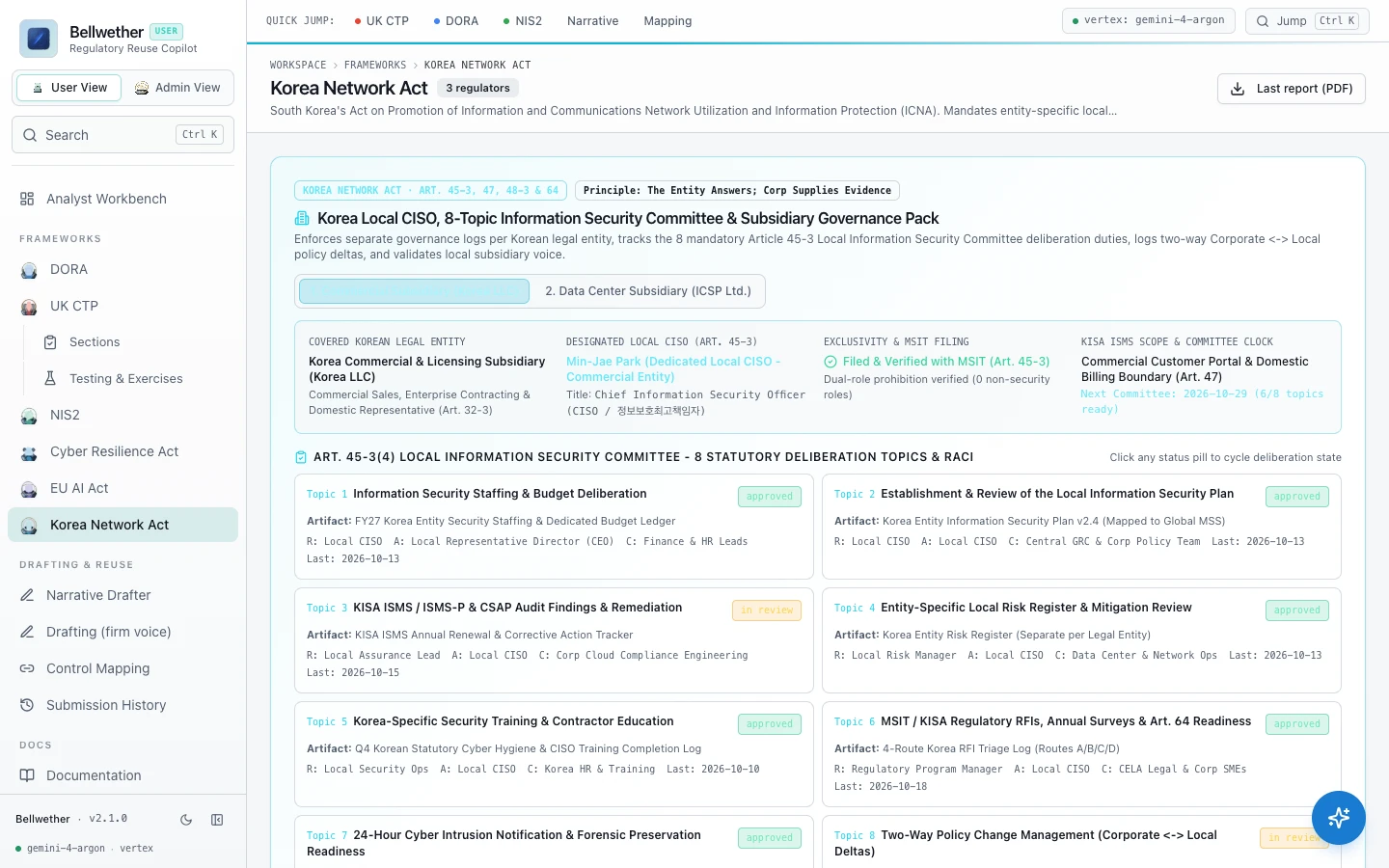
/f/korea_network_act) workbench. Above the fold sits the Article 45-3 Local CISO and 8-Topic Information Security Committee portal with subsidiary switching, bidirectional policy delta logging, and the Entity Voice validator; below it sits the Multi-Question 4-Route Engagement Pack. Open full size.3. Cross-Regime Obligation and Incident Clock Comparator (Phase 3)
Finally, compliance teams answering multi-regime inquiries constantly have to reconcile subtle statutory divergences across jurisdictions. We built CrossRegimeMatrix.tsx on /mapping?tab=cross-regime to compare DORA, UK CTP, NIS2, and the Korea Network Act side by side across five canonical domains (Incident Notification Clocks, Executive & CISO Governance, Fourth-Party Concentration, Resilience Testing & Certifications, and Supervisory Inspections):
- Strictest Common Denominator: Synthesizes the global control target that satisfies all four regimes simultaneously (for example, an Immediate / sub-4-hour initial incident trigger paired with 24-hour KISA/NIS2 early warning and 72-hour DORA/NIS2/PIPC intermediate updates).
- Jurisdictional Divergence Traps: Highlights where a global baseline fails locally, such as relying on ISO 27001/SOC 2 in place of Korea’s mandatory KISA ISMS-P/CSAP certification (Article 47) or assigning a dual-hatted regional executive in violation of Korea Article 45-3.
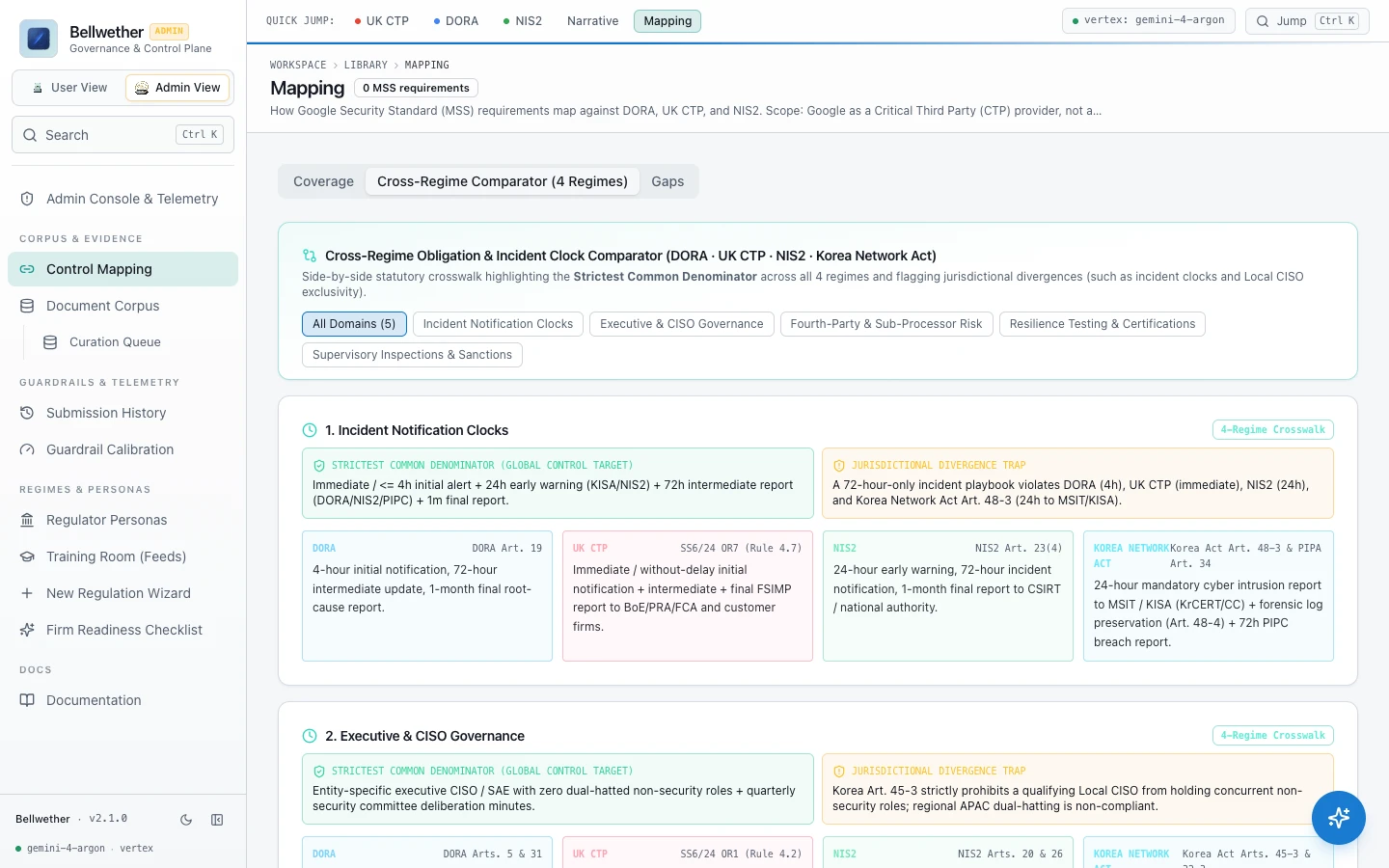
/mapping?tab=cross-regime. Each domain surfaces the Strictest Common Denominator alongside jurisdictional divergence traps across DORA, UK CTP, NIS2, and the Korea Network Act. Open full size.Verification and What Is Live Now
Every phase of the Bellwether v3.0 build is backed by automated regression tests and deployed to Cloud Run via canary smoke-test promotion:
- Test Suite:
556 passed, 0 failedinpytest(includingtests/test_bellwether_v3_features.pycovering Korea Network Act narrative domains, anchor regulators, MSS obligations, 4-Route triage classification, Incident Path detection, Route D422privilege locking, and Data Hub fact verification) and0TypeScript errors intsc -b && vite build. - Calibrated Guardrails: 69-case GShoe staleness regression suite (
97.2%catch,3.1%false-fresh,94.6%precision) + 18-case Data Hub independence-discounted trust suite (100%accuracy,0.0%false-green rate). - Live Production Runtime: Serving on
bellwether.neural-bridge.devwith Gemini 4 Argon (gemini-4-argon) on Vertex AI global, Claude 5.5 on Anthropic direct, 19 regulator personas across 4 core regimes (+ dynamic EU AI Act and Cyber Resilience Act), and bespoke 3D Blender architectural emblems.
The lesson from this overhaul mirrors what I learned rebuilding Moonbase earlier this week: a great core algorithm (like a cross-family staleness guardrail or an independence-discounted trust equation) only delivers its full value when the surrounding workflow closes the loop from intake to verified write-back.